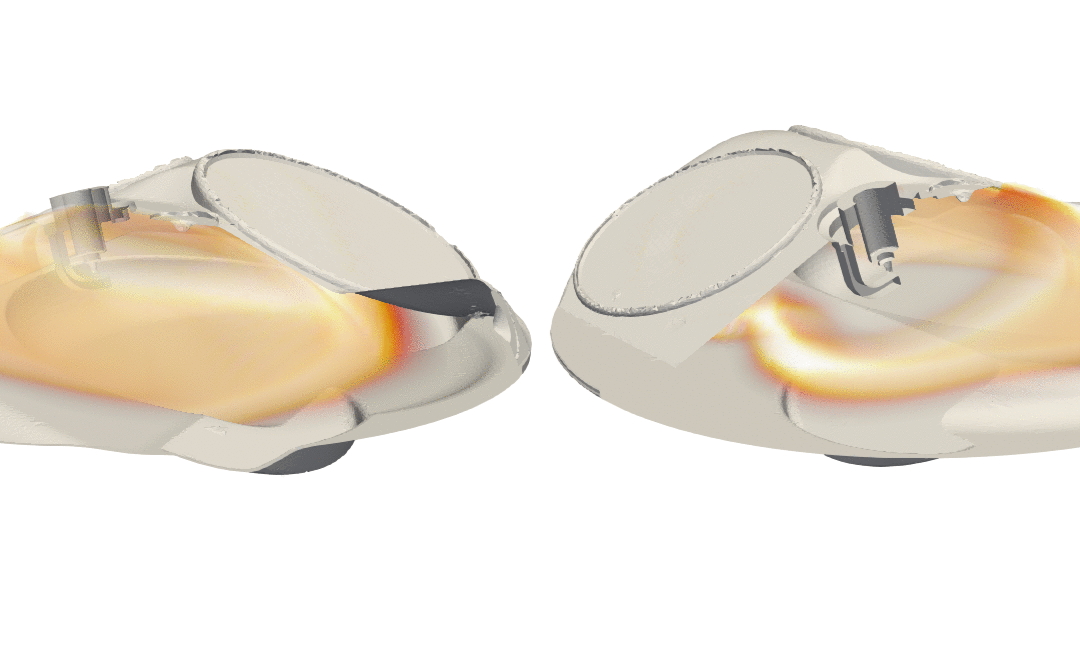
The test bench calibration campaign was divided into two sequential phases, starting with CNG operation to establish a solid performance and functional baseline. During this initial phase, injection and ignition parameters were optimized to ensure combustion stability and to map the fluid-dynamic behavior of the engine. Once the methane reference models were validated, the focus shifted to pure hydrogen calibration, refining transient operation and analyzing the thermomechanical response of the powertrain across various loads.
The transition to hydrogen required a major revision of the air management strategies, particularly within the lean-burn operating regime adopted to maximize efficiency and suppress NOx emissions. Because hydrogen exhibits a very low volumetric density and lean combustion demands a substantial excess of air, the volume of the fresh charge increases significantly, which inherently tends to reduce the engine’s specific power. To compensate for this displacement effect and deliver the necessary air mass into the cylinder to maintain the target equivalence ratio, it was essential to increase the boost pressure via the turbocharger. This strategy successfully restored the intake charge density, ensuring the target power output even when operating with extremely lean mixtures.
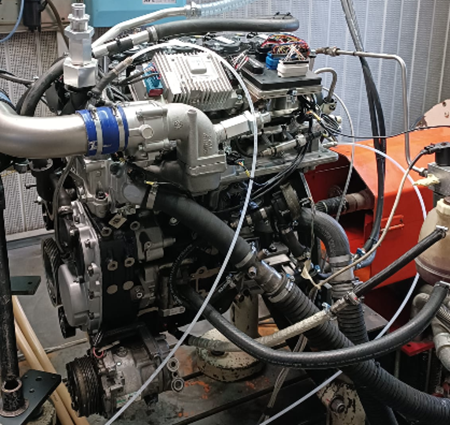
Following the successful completion of the calibration phases, a comprehensive comparative analysis was conducted to evaluate the engine’s performance, efficiency, and emission profiles when shifting from methane to pure hydrogen operation. By cross-referencing the experimental data collected under identical engine speed and torque targets, this analysis isolates the impact of hydrogen’s unique combustion properties—such as its high flame speed and broad flammability limits—against the baseline established by methane.
Particular focus is placed on assessing how the increased boost pressure and lean-burn strategies influenced thermal efficiency and NOx formation, ultimately providing a clear indication of the conversion’s viability and highlighting potential areas for future hardware optimization.
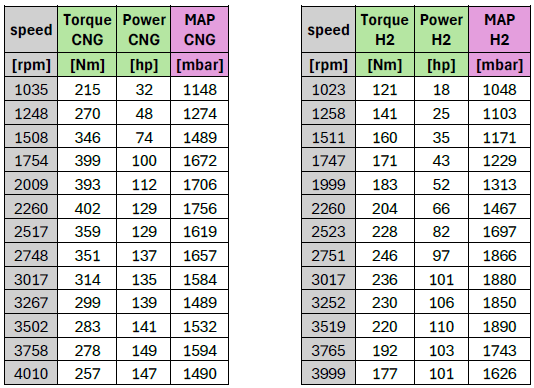
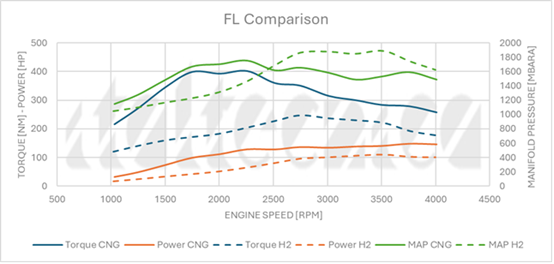
A comparative assessment of the full-load curves reveals that while the hydrogen configuration exhibits a lower power and torque output across the entire engine speed range compared to the CNG baseline, the performance penalty is significantly less severe than standard theoretical predictions. In conventional PFI hydrogen engine literature, running lean mixtures often translates into a drastic 50% to 70% drop in power density due to the low volumetric energy density of hydrogen and the massive displacement of fresh air in the intake manifold. However, the experimental data gathered on the test bench demonstrates that the engine successfully mitigated these losses, maintaining much higher performance levels.
This major improvement is particularly evident when analysing specific operating points. For instance, at approximately 2260rpm, where the CNG setup reaches its peak torque of 402Nm (129hp), the hydrogen configuration still delivers a substantial 204Nm (66hp). At higher engine speeds, such as around 3500rpm, the performance gap closes even further: the hydrogen setup produces 110hp compared to the 141hp of CNG, restricting the actual power loss to roughly 22%. This exceptional result proves that the aggressive turbocharging strategy and optimized MAP (Manifold Absolute Pressure) management—which reaches up to 1890mbar under hydrogen operation to restore air mass flow—successfully countered the volumetric efficiency penalties typical of PFI hydrogen conversions.
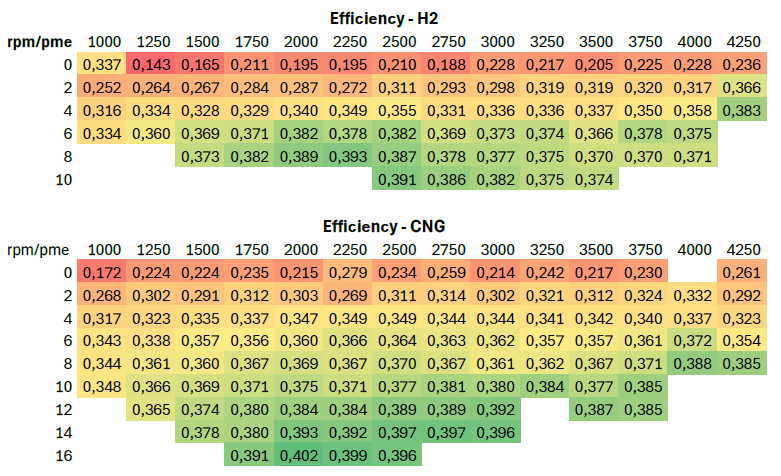
The engine’s brake thermal efficiency was thoroughly mapped as a function of engine speed (x-axis, in rpm) and brake mean effective pressure (y-axis, in bar). When cross-referencing the two operating maps, the hydrogen configuration consistently demonstrates a superior efficiency profile compared to the CNG baseline at every shared operating point. For instance, at mid-load conditions such as 6 bar BMEP and speeds between 2000rpm and 3000rpm, the hydrogen setup achieves efficiency values hovering around 37.3% to 38.2%, whereas the CNG baseline remains noticeably lower, ranging from 36.0% to 36.6%. This systematic advantage stems directly from hydrogen’s fundamental combustion properties, namely its significantly higher laminar flame speed and wider flammability limits, which promote a faster, more isometric heat release closer to ideal Otto cycle conditions, thereby reducing thermodynamic losses..
Furthermore, a deeper analysis of the peak efficiency zones highlights the strengths and structural limitations of both configurations. The CNG setup reaches its absolute maximum efficiency of 40.2% at high-load islands (2000rpm and 16 bar BMEP), a region that the PFI hydrogen configuration cannot currently access due to the torque penalties and lean-burn volumetric limits discussed previously. However, within its own operating envelope, the hydrogen engine peaks at an impressive 39.3% at 2250rpm / 8 bar BMEP and maintains values as high as 39.1% at 10 bar BMEP. This indicates that while hydrogen operation yields a restricted maximum BMEP, it shifts the high-efficiency island toward lower loads. This trait is highly beneficial for real-world driving cycles where the engine primarily operates under partial load conditions, resulting in significantly lower fuel consumption.